What to bring
- A Mahjong set: 144 tiles with bonus tiles, or 136 without.
- Dice and a round-wind marker or note.
- Optional: a score sheet or counters.
Hong Kong Mahjong
Four players, four walls, and two kinds of wind. Get the table ready and learn where you fit before the first discard.
Seat four players around a square table, leaving room for tile walls and a central discard area.
Agree on bonus tiles, minimum faan, scoring rules, and game length. The dealing method below is one common Hong Kong approach; customs vary.
Each player has a seat wind: East, South, West, or North. East is always the dealer. These are game roles. This arrangement differs from a compass map
Randomly choose one player to be the first dealer (East).
During play, keep your concealed tiles facing you, reveal claimed groups in front of you, and put flowers and seasons to one side.
Mix all the tiles thoroughly so nobody can see their faces. Remove unused tiles from other formats such as jokers.
With 144 tiles, each player builds 18 stacks, two tiles high: 36 tiles per wall. Push the walls towards the centre to form a square.
A short wall section: each vertical pair is one stack.
In this method, East rolls three dice. Count players counter-clockwise, starting with East as 1 and continuing around as needed. The total selects whose wall to open. From that player’s perspective, count the same number of stacks from their wall’s right end and open a gap after the counted stacks.
For example, a total of 8 lands on North: East 1, South 2, West 3, North 4, then repeat. Count eight stacks from the right end of North’s wall and break after them.
Start with the first uncounted stack beyond the gap; the counted stacks form the back end of the wall. Give East, South, West, and North four tiles each (two stacks). Repeat twice more so everyone has 12. For a straightforward beginner deal, give each player one more tile and East an extra tile: East has 14; everyone else has 13. Take the top tile of a stack before the bottom and continue along the wall clockwise.
Starting with East, reveal any flowers and seasons and draw replacements from the back end of the wall. Repeat if a replacement is another bonus tile. Keep these tiles separate from the 14- or 13-tile hand. East begins by discarding one tile without drawing; South takes the next turn.
Ordinary draws come from the front of the wall. Flower and kong replacements come from the back.
Personal to each player
Your role for the current hand. The four players have four different seat winds. When the dealer changes, everyone’s seat wind changes too.
Shared by the table
Also called the prevailing wind. It starts at East and stays the same through a complete circuit of the deal. It does not change after every hand.
| Player’s old seat wind | New seat wind |
|---|---|
| East | North |
| South | East · new dealer |
| West | South |
| North | West |
After all four players have completed their turn as dealer and the deal returns to the round’s starting player, advance the round wind. A full game has East, South, West, and North rounds. Dealer repeats add hands, so a full game can last longer than 16 hands.
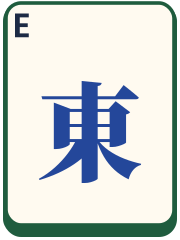 East roundFirst
 South roundSecond
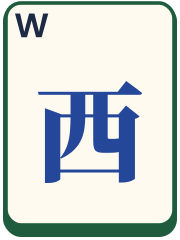 West roundThird
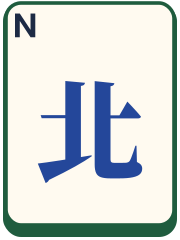 North roundFourth
A pong or kong matching your seat wind or the round wind can earn faan. Your seat wind also determines your matching bonus number: East 1, South 2, West 3, North 4.
Example: you are South during the East round. South is your seat wind; East is everyone’s round wind. A pong of South can score for your seat, and a pong of East can score for the round. Your matching flowers and seasons are numbered 2.
The table is ready. Next, learn how to score your hand and count faan.
Explore Scoring & FAANRules references: Mahjong House’s setup and dealing rules and MyMahjong’s winds guide. Agree house rules before playing.